
Quantum Industrial Solutions Inc. • May 12, 2026
Why Replacing a Deteriorated Manhole Is Often the Wrong Call?
When a manhole fails, excavation often feels like the obvious fix. In many cases, however, manhole rehabilitation is the more efficient and cost-effective solution. Here’s what engineers and asset owners should consider before approving full replacement.
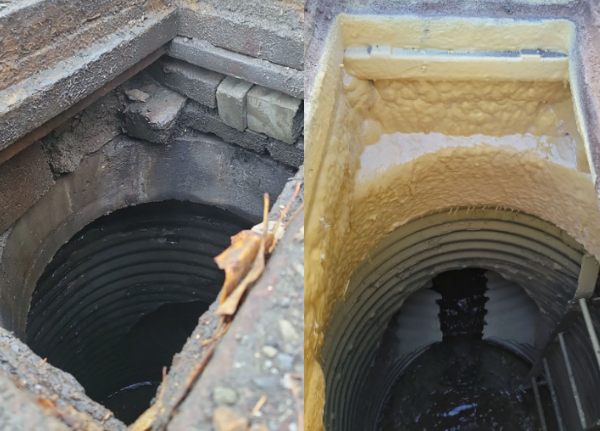
A municipality discovers a deteriorated manhole on a critical interceptor. The concrete is spalling. There’s active infiltration. H₂S corrosion has eaten into the wall profile. The default recommendation: replace it.
Before that decision gets made, it’s worth asking a harder question: What is replacement actually buying you — and at what cost?
The real cost of manhole replacement
Full manhole replacement means excavation. That means traffic management, potential road closures, disruption to nearby utilities, bypass pumping, and extended outage windows. In urban corridors or near critical infrastructure — a gas main, a live sewer crossing, a transit corridor — excavation risk escalates quickly.
Direct construction cost is only part of the picture. Project owners also absorb schedule delays, third-party coordination costs, and the risk that excavation uncovers additional problems that weren’t priced.
On a recent Metro Vancouver project, manholes MH 38 and MH 39 sat directly above a live gravity sewer and adjacent to the Trans Mountain gas main. Full replacement was not feasible. QIS rehabilitated both structures above live flow, without bypass pumping, with zero WorkSafeBC orders — and returned them to service in under 30 minutes per structure.
When rehabilitation is the right answer
A spray-applied structural liner — specifically SprayRoq SprayWall — can restore a deteriorated manhole to full structural and corrosion-resistant performance without excavation. The liner is applied in confined space using plural-component heated equipment, cures rapidly, and acts independently of the existing concrete if the host substrate degrades further.
The key conditions that make rehabilitation viable:
The host structure still has geometric integrity
If the manhole is spalling and corroded but hasn’t collapsed or significantly deformed, spray-applied rehabilitation is a legitimate structural option. The liner is designed to act as an independent structural element, not just a protective coating.
Active infiltration can be controlled prior to lining
Infiltration at joints, wall interfaces, or penetrations is addressable through injection grouting — typically hydrophobic foam to stop flow, followed by hydrophilic foam to seal permanently. QIS sequences this before lining as standard practice.
Access and confined space conditions are manageable
Modern confined space protocols — supplied air, continuous gas monitoring, real-time upstream level verification, tripod retrieval — allow work to proceed safely above live flow. The question isn’t whether the environment is challenging. The question is whether the planning and competency are adequate to the environment.

What this means for project engineers and asset owners
Rehabilitation doesn’t mean cutting corners. A properly engineered spray-applied liner — designed to the correct thickness using deflection-based methodology, applied over a properly prepared CSP 4–6 substrate, with documented QA/QC including DFT verification and ASTM/NACE compliance — is a defensible structural decision.
For engineers worried about specifying something unfamiliar: the data is there. SprayRoq’s flat-wall design methodology accounts for square geometry, saturated soil and hydrostatic loading, and partial concrete deterioration. The liner thickness is calculated, not estimated.
For project managers concerned about schedule: the work is typically completed in a fraction of the time required for excavation and replacement, with no bypass pumping required on gravity systems with manageable flow conditions.
For asset owners concerned about long-term performance: the liner is independent of the host concrete. If the substrate continues to deteriorate after lining, structural capacity is retained.
The decision framework
Before approving manhole replacement, run this checklist:
Is the structure geometrically intact enough to accept a liner? Has infiltration control been assessed? Are confined space conditions manageable with proper planning? Is excavation actually feasible given the surrounding constraints? What is the true, fully-loaded cost of replacement versus rehabilitation?
If the answers point toward rehabilitation, the technology exists, the track record is real, and the contractor competency question is the only remaining one to resolve.
QIS has completed manhole rehabilitation under live flow, above critical infrastructure, in H₂S-rated sanitary environments, with zero service interruptions and documented 50+ year design life outcomes. If you have a structure that warrants a second opinion before replacement is approved, we’re worth a conversation.
Have a deteriorated manhole that’s been flagged for replacement?
Contact QIS before the excavation gets approved.